
I don’t enjoy embarrassing myself. I don’t enjoy failing. I also don’t enjoy falling off horses. Shocking right??? While the vast majority of us probably don’t enjoy any of the above, we also probably don’t realize how OFTEN we actually think about all of those things happening.
You may be of the “I should always feel fine and be a badass” variety and feel like you should NEVER give life to those fears. Keep these thoughts to yourself, bury those feelings and for the love of all baby horses everywhere don’t EVER talk about it. I think a lot of us fall into this camp, we feel like we should be brave at all times and if we ride horses we certainly can’t be afraid to ride horses. Spoiler Alert: We are all scared, we just don’t talk about it.
While you may or may not want to talk about riding anxiety, it’s there and so are it’s besties: Worry Thoughts. Whether you struggle with a lot or a little riding anxiety (or any type of anxiety for that matter) you experience worry thoughts. They are those salty, annoying “what if” thoughts that sneak in at all the wrong times. Some are automatic and some are manufactured through unfortunate circumstances or experiences. These worry thoughts will then band together and create your perspective. This is your general outlook toward yourself, others and the world around you.
The beauty of perspective is that we are in the driver seat. We get to choose what things mean to us. Maybe not automatically, those sneaky little thoughts are called automatic thoughts, but in the long run we have control over what thoughts mean to us.
What are automatic thoughts you ask? Well let me throw on my therapist spectacles and tell you. Automatic thoughts are those thoughts that just pop in; “I’m so stupid”, “I’m going to fall off”, “Everyone is going to make fun of me if……” fill in the blank. The combination of snarky things we can say to ourselves can be endless. My point is, these kinds of thoughts can just pop in, whether we fully subscribe to the ideas or not.
Now I am NOT saying that we are powerless over these thoughts, simply that they pop in automatically without our conscious choice to think this way. Where we go from there is completely up to us. We decide if we feed into it or we reframe it.
“I’m going to fall off” can be fed into: “I’m going to fall off, I won’t want to get back on but I have to. I’m going to be scared riding now. My horse can tell if I’m anxious and he will start acting out, I’ll never be able to ride him again and everyone will think I’m the worst rider EVER.” This may sound extreme or it may feel like I’m reading your mind. Either way, it illustrates my point.
You can choose how you respond and there are A LOT of ways to do so. (Surprise, making room for and is my favorite, act surprised when we get there)
Here are a few options:
The Positive Reframe Response
“I’m going to fall off” can also be reframed. “I won’t fall off, it’s okay just breathe and walk a minute”, that’s a positive reframe. While it is helpful, it is not always available to us in the moment.
Now I cannot stress this enough, do NOT tell yourself that you shouldn’t feel this way. Shoulding on yourself is not productive and is often just an attempt to motivate yourself through guilt. As you can imagine that will not end well.
How you feel is how you feel. End of story. Telling yourself not to feel a certain way only makes you feel terrible and can actually make the negative feelings more intense.
It’s like trying to ignore a 3 year old. How well does that work out?
You can positively pep talk yourself with this reframe, though please, for the love, avoid invalidating yourself in your reframe.
The Validation Response
“It’s okay to worry about falling off, falling off is scary!”
It’s only natural I give a nod to validation after telling you not to invalidate yourself. When we validate ourselves we say “I see you feelings”. Falling off of a horse IS scary and if you try to convince yourself it isn’t your setting yourself up for failure.
There is nothing wrong with validating your feelings, though you want to keep this time limited. Validation can easily turn into feeding your worries if left unchecked.
The Non-Judgemental Response
“I might fall off”
I love DBT. Dialectical Behavioral Therapy, Google it, it’s great! In DBT there is a lot of discussion about non-judgemental stance. Since I have a lot more to say I won’t expand on this as much as I would like to.
Essentially a non-judgemental stance challenges you to NOT categorize something as good or bad, it just is what it is. So, with this example, falling off a horse is falling off a horse. That’s it. It isn’t the worst thing that ever happened to you, it isn’t the best thing, it’s just a thing.
May seem a bit robotic at first glance, but it is one of the more easily accessible reframe when you are feeling emotionally flooded. It can also be really liberating and borderline Zen-like in the moment. Try it on!
The Lean In Response
“Yup, I might fall off and then I’ll get back on and keep it moving.”
I enjoy the “Lean In Response” as I like to phrase it. There’s some radical acceptance in there as well as a bit of a pep talk, what’s not to love. There’s something magical about that person who just accepts reality and spits the truth. You can be that person and also tell yourself everything is going to be okay too.
The Permission Slip Response
“If I get too scared I can get off.”
Having permission to just take a breath and regroup can feel amazing. There’s no reason that you can’t give yourself permission to NOT do something that is making you anxious unless it starts to turn into avoidance.
Avoidance versus conscious choice is a loaded topic in my opinion. One I’m sure I will weigh in on more at one point or another.
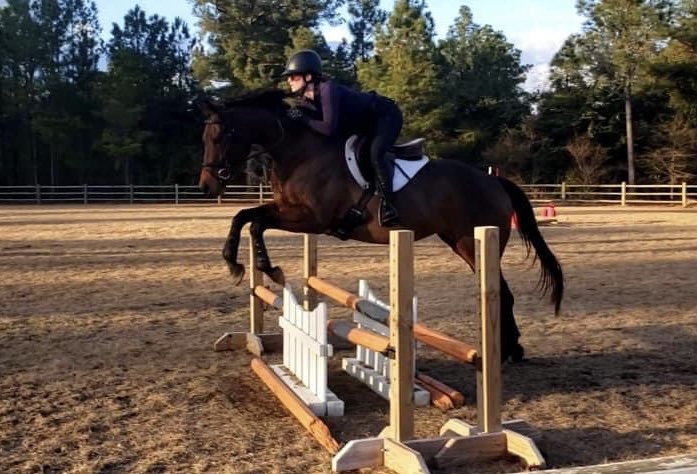
What we are discussing here is giving yourself permission to not do something if you decide doing it is intolerable. For example: Sometimes I get anxious when I’m jumping. I’ve given myself permission to stop jumping if I really feel I need to and guess what? I’ve very rarely needed to stop jumping. (The picture above is of me jumping an amazing friend’s wonderful horse….. with a permission slip to NOT jump metaphorically in my back pocket.)
Because I gave myself permission I stopped judging myself (well I at least stopped doing it as much, I’m only human okay!) I stopped feeling so pressured and guilty about potentially not wanting to do it. I worried less that others would think I was a wiener and I wasn’t a good rider. I’m also a bit spoiled and have an amazing trainer who just gets it.
Regardless, write that permission slip, literally or figuratively, whatever works, you do you!
And drumroll please, my personal favorite…….
Make Room for And
“I can fall off and keep riding.”
If you have read anything I’ve written you know I love dialectics, two seemingly opposite things existing together. You know, since those options do exist together anyways. We might as well acknowledge it.
You and I can fall of the horse and then get back on. Hell I had the horse fall ON TOP OF ME and I still eventually got back on. You can too. Not only can you do it, you can tell yourself you can do it.
This approach combines a lot of the above. It’s validating, it’s leaning in, it’s non-judgemental, there’s a bit of permission sprinkled in and even some positivity. Is it any wonder why making room for and is my favorite?
To Sum it All Up
You have choices when it comes to how you think and how you talk to yourself. If you worry about what others think, embarrassing yourself, failure, falling off the horse…… you are not alone. You also don’t have to sit in the worry and do nothing about it. Worry is powerful but you aren’t powerless.
Try on some of the options above, these approaches can feel strange since anxiety pushes us to feed into worry thoughts not challenging them. All of these skills work for someone, but no one skill works for everyone. Find what works for you!
Also, give yourself time. If you think about how long these thoughts have gone unchecked you can’t expect to reframe the thought once and BAM it’s gone. Expecting anxiety to just go away and never come back is unrealistic, but it doesn’t have to dictate your thoughts and actions. You’ve got this.
Enjoy your ride my friends.
 Advanced Beginnings